
What a contrast!
From the gloom of Wagner’s Parsifal to the merriment of Verdi’s Falstaff is a joyous leap for us this Glyndebourne season. (Mind you, we had Verdi’s sadder Traviata only a fortnight ago!)
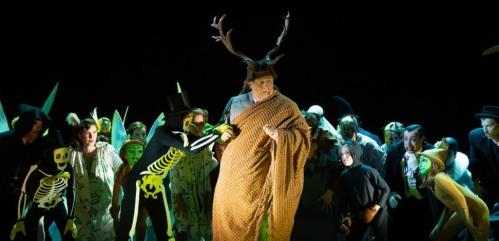
Modern productions of Verdi’s Falstaff, and the Merry Wives of Windsor its Shakespearean muse, are frequently, curiously, set in Tudor England (and not the early fifteenth century England of Agincourt) – so setting it in 1940s Windsor seems absolutely OK, until the final scene when medieval credulity would work better in ‘selling’ Falstaff’s humiliation.
All, of course, it is Glyndebourne, sung well, but Renato Girolami (Falstaff) and Mariam Battistelli, as the ingenue Nannetta fated with a forced marriage to the oily Doctor, were outstanding, Battistelli in particular, and well acknowledged by the audience. She should have a significant career ahead of her.
We last saw Falstaff in 2021 with Bryn Terfel. He (or his director) saw the character as a (loveable) rogue – our Falstaff in 2025 was more a sociopathic chancer. Both sides are there in Shakespeare, of course, but they trigger different audience responses.
Bryn was the better loved, I feel.
Although there is little choral work in the opera, and mainly in the final scenes, Glyndebourne was well served both by its adult Chorus and its child actors, including some hard working Brownies (the incipient Girl Guide sort, not the ur-fairy, although doubling as such in the final Windsor Great Park scene).
It delivers in musicality and spectacle, but somehow I felt slightly short-changed. But then I have seen Bryn Terfel in the part!