
A well made play without a kitchen sink in sight...
It’s the Press Night for Nye, so we’re next door at the Lyttleton to see Dear Octopus.
This is Dodie Smith’s 1938 play – its London First Night on 14th September 1938 being the one on which Chamberlain flew to Munich to bring back ‘peace in our time’. The news of this came during the first interval, which helped push the play into a success as the audience’s mood was wholly lifted (and how wrong they were, at least about Chamberlain’s Munich dash).
It’s therefore curious that in this production the on-set radio has broadcasts from a little less than a year later telling of the preparations for actual war; without any mention of this in the actual play as written (!), which leaves the Randolph family as the most solipsistic in history, as Britain enters war and they worry about a social event.
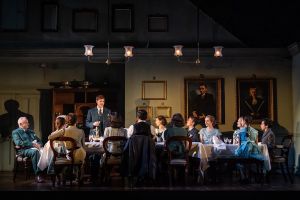
The set is two rooms of what must be a largish country house, which swing through on a revolve, with a children’s nursery suite which flies down when required.
It’s a play (particularly in the light of the radio broadcasts) in which nothing happens, a couple of trivial problems are resolved and there’s a romance. It works, and it does work, because the nothing that happens is engaging and witty, with characters which intrigue, and if well played, and this was, with Lindsay Duncan excelling as the matriarch and Malcolm Sinclair as her spouse of 50 years (the social event), with characters who engage the audience.
[The first ‘first night’ had John Gielgud as the romantic lead; Marie Tempest as the matriarch and Angela Baddeley as the eventual object of Gielgud’s affections; possibly a stronger cast overall].
Almost (with Rattigan) the archetype of the ‘well made play’, this is a wholly enjoyable country house ensemble of a dysfunctional family for whom ‘family’ (the Dear Octopus of the title) is still paramount.
But why were the uncanonical wartime broadcasts inserted? It just makes them look like idiots, never mentioning it once, especially as one of the family was killed, at the exact same age as his son, in the play, during the previous unpleasantness.
But this aside, it's a play that was worth reviving, for the fun and the performances.